PRRDB 2.0 : Pattern Recognition Receptor Database

  • Home
  • Search
    • Basic Search
    • Advanced Search
  • Browse
    • By Receptor
    • By Ligands
    • By Receptor's source
    • By Ligand's source
    • By Receptor's Structure
      • Available Structures
        • C-Type Lectins (CTLs/CLRs)
        • Gram negative binding Proteins(GNBPs)
        • 1,3-β-D-Glucan Pattern Recognition Protein(GRPs)
        • Lectins
        • Mannose Receptors (MRs)
        • Nod like Receptors (NLRs)
        • Peptidoglycan Recognition Proteins (PGRPs)
        • Rig like Receptor (RLRs)
        • Scavenger receptors (SRs)
        • Toll like Receptors (TLRs)
        • Others
      • Predicted Structures
  • Tools
    • Blast Search
    • Smith-waterman
  • Information
    • Other Resources
    • Statistics
    • Data Submission
    • Acknowledgment
    • Help
  • Developers
    • Team
    • Contact us

Help

This page provides help to the users of PRRDB 2.0 database on how to efficiently use this repository of pattern recognition receptor. For each module which is implemented in PRRDB 2.0, here we provide the figures and description on how to use that module. Four general modules are provided here.

Search Module


Basic Search
This module displays the basic search page of PRRDB 2.0. Clicking on the required field will allow the user to browse the specific information in the database. The "Select Fields to be SEARCHED" section provides options for various keywords through which search can be made in PRRDB 2.0. User can select fields to be displayed from the section "Fields to be DISPLAY". User can click on each PRR ID to get all the details regarding the entry. User can also click on each peptide to know information about that receptor.

Pic-1


Top

Advanced Search
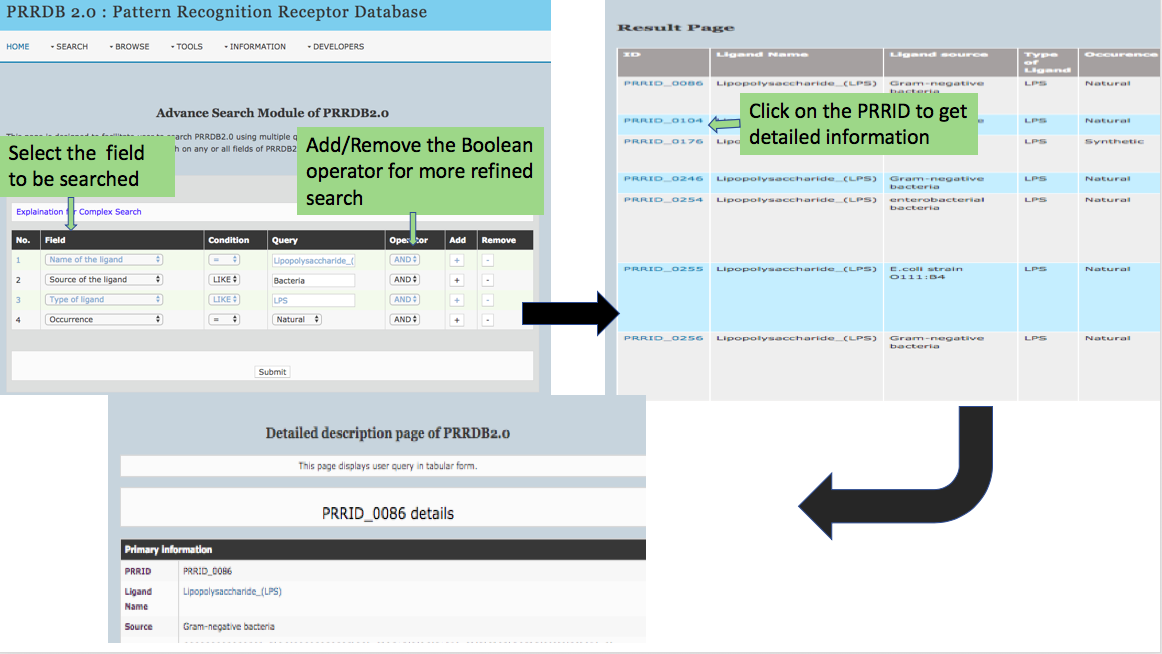
This page provides the advanced search facility in PRRDB 2.0. User can browse the page by selecting multiple fields.

Pic-1

Top

Browse page


Browse by Receptors
All the receptor in the database belong to the following classes of receptors:
  • Toll-like receptor
  • Mannose receptor
  • Scavenger receptor
  • NLRs
  • C-type lectin like family domain receptors
  • PGRPs
  • Others
So if a user wants to retrieve the information about all the members of a class of receptors, he/she can choose the relevant option from the option box. A user can restrict the fields to be displayed in the Result page. If user did not select any check box then only the entry No. and the query will be displayed. All the publication references are hyperlinked to Pubmed,sequence is hyperlinked to swiss prot ID, textual description is also avaiable for ligands through hyperlink. The result screen will show "No record found under specified condition" when no relevant data is found in the database.

Pic-1

Top

Browse by Ligands
For convenience all the ligands in the database are classified into following types depending upon their chemical composition:
  • Nucleic acid
  • Protein
  • Carbohydrate
  • Peptide
  • Lipopolysachharide
  • Peptidoglycan
  • Glycolipid
  • Glycoprotein
  • Others
So if a user wants to retrieve the information about all the members of a class of receptors, he/she can choose the relevant option from the option box. A user can restrict the fields to be displayed in Result page. If user did not select any check box then only the entry No. and the query will be displayed. All the publication references are hyperlinked to Pubmed, sequence is hyperlinked to swiss prot ID, textual description is also avaiable for ligands through hyperlink. The result screen will show "No record found under specified condition" when no relevant data is found in the database.

Pic-1

Top

Browse by Receptor's structure
For structure detail all the receptors in the database are classified into following types:
  • CTL
  • Gram negative binding proteins(GNBPs)
  • GRPs
  • Lectins
  • Mannose Receptor(MRs)
  • Nod Like receptor(NLRs)
  • PGRPs
  • Pattern recognition receptor(PRRs)
  • Rig Like receptor(RLRs)
  • Scavenger receptor(SRs)
  • Toll like receptor(TLRs)
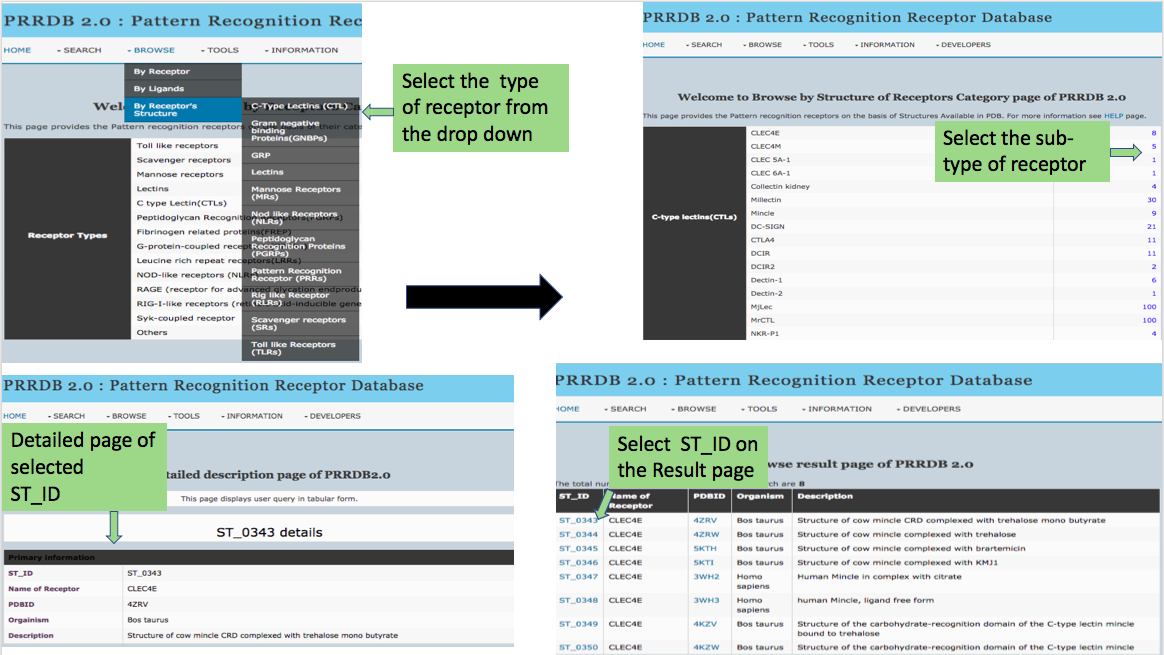
So if a user wants to retrieve the information about all the members of a class of receptors, he/she can choose the relevant option from the drop down option. He/she can choose a sub-type of that receptor. A result page will pop out from where user can choose ST_ID for detail information. can restrict the fields to be displayed in Result page. All the receptor's structure(Pdbid) is hyperlinked.

Pic-1

Top
Top

Tools


BLAST Search
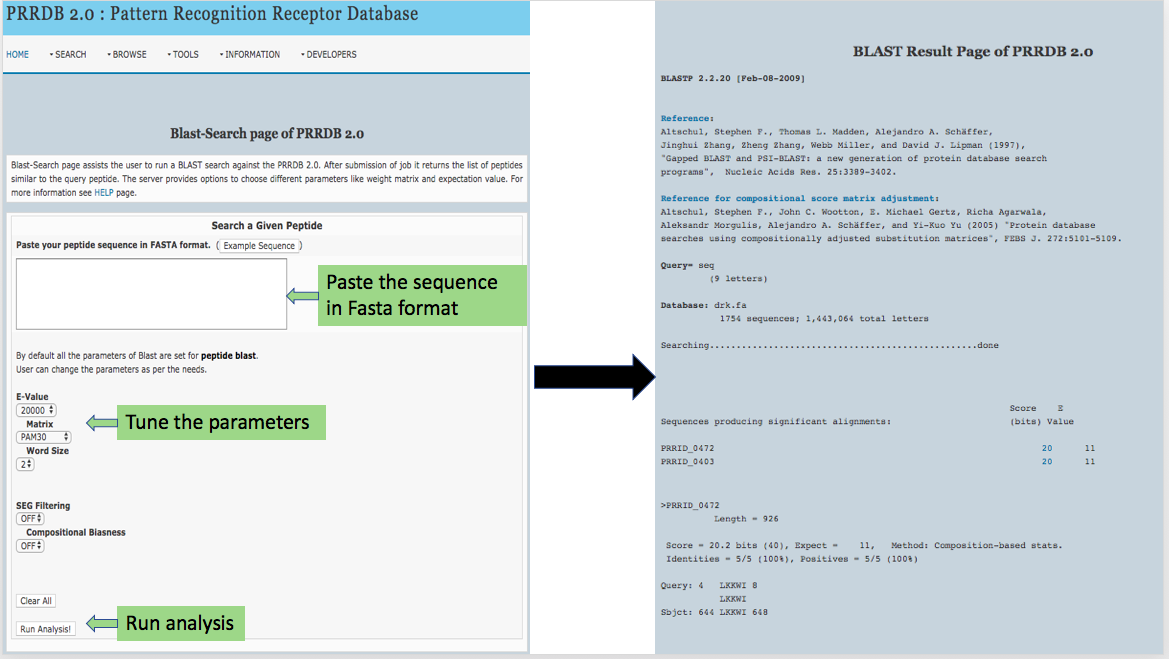
This option allows users to search sequences similar to their query protein against a database of PRR sequences maintained at PRRDB 2.0.

Pic-1


Top

Smith Waterman Mapping
This page perform local alignmnent and provides similar regions between two strings protein sequences

Pic-1

Frequently Asked Questions (FAQs)


Q1. What is PRRDB 2.0?
Ans. PRRDB 2.0 is an updated version of PRRDB (released in 2008) which is a comprehensive repository of experimentally verified pattern recognition receptors and their ligands.

Q2. Why PRRDB 2.0?
Ans. It comprises more than 2000 entries from the literature available on Pubmed. It gives all the information related to pattern recognition receptors like its Ligand, source of ligand, function of ligand,occurence of ligand, receptor, receptor source, Function of receptor, assys used, etc.

Q3. How to search into PRRDB 2.0?
Ans. A user can search by Ligand name or search by Receptors name. Facility of simple search and advanced search is also available for user friendly experience.

IIITD

Raghava's Group