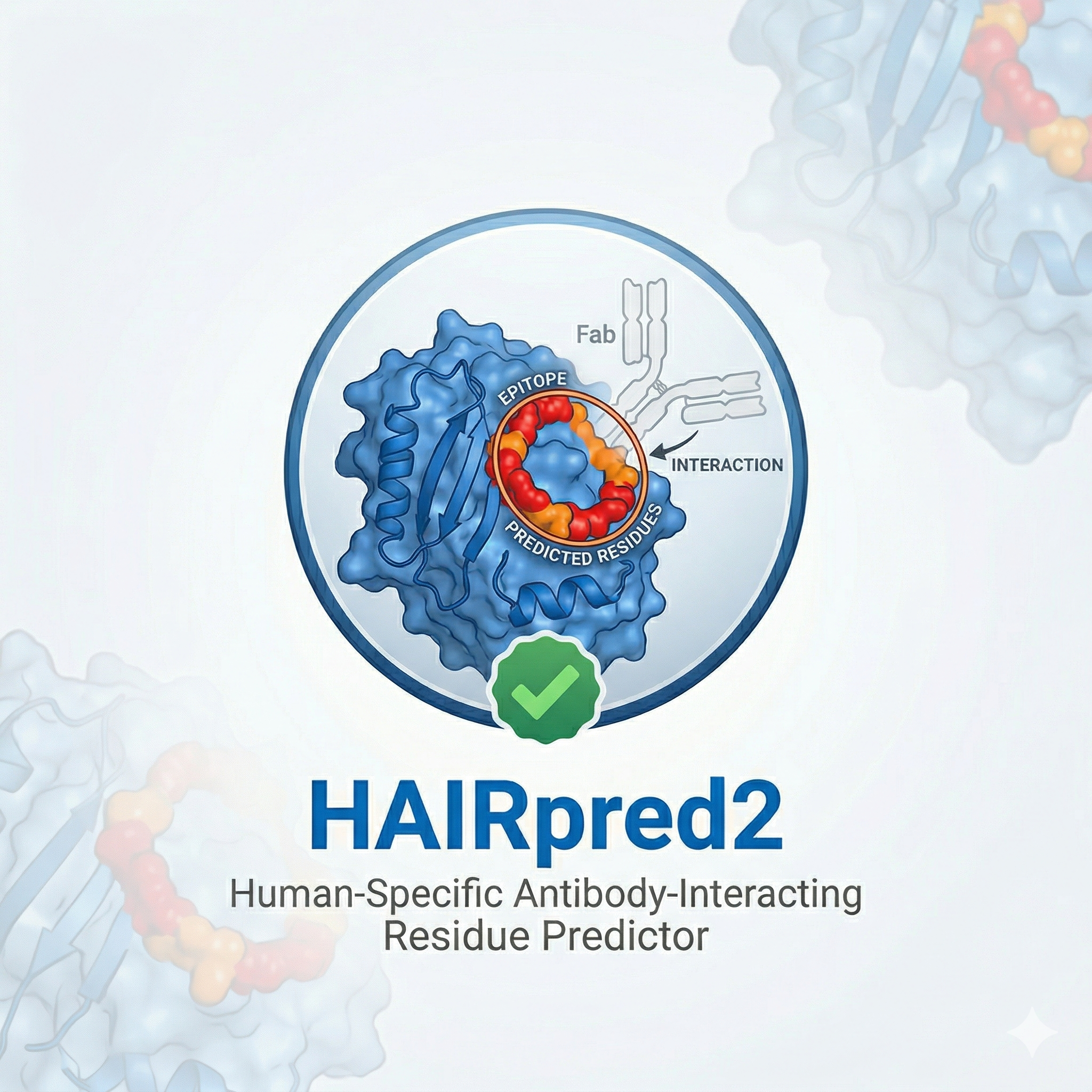
Unlike sequence-based tools, HAIRpred2 uses 3D structural information for residue-level epitope prediction.
Structure-Based Input
Accepts standard PDB files. Uses DSSP to compute Relative Solvent Accessibility (RSA) for each residue directly from 3D coordinates.
Human-Specific Model
Trained exclusively on 277 human Ag-Ab complexes from SAbDab — captures unique features of human immune recognition.
Hybrid Feature Set
15-residue sliding window encodes RSA + pI, pKa, hydrophobicity, steric, and EIIP — 105 features per residue.
Epitope Patch Detection
Clusters spatially adjacent interacting residues (Cα < 10Å) into epitope patches — regions antibodies actually bind.
PyMOL-Ready Output
Generates a .pml script for direct PyMOL loading — red/blue coloring with probability labels on every interacting residue.
Standalone Available
Download Python standalone for local use. Supports multiple chains, RSA filtering, and custom probability thresholds.