How AntiCapt's model works
Aptamers are short synthetic DNA strands that fold into shapes precise enough to bind a target the way an antibody would — a growing route to anticancer therapeutics and diagnostics. AntiCapt does not compute hand-crafted sequence statistics; instead, each input sequence is passed through a HyenaDNA long-range genomic language model that has been fine-tuned on anticancer-aptamer data, and the model's internal representation of the sequence (its final hidden state, mean-pooled across positions) is used as a learned embedding.
That embedding is scored by a LightGBM classifier (with a matching feature scaler), trained on experimentally validated anticancer and non-anticancer DNA aptamers. Two independently trained model pairs are provided: the Main dataset model (anticancer aptamers vs. random oligonucleotides) and the Alternate dataset model (anticancer aptamers vs. general-purpose aptamers from public databases) — both use the same fine-tuned HyenaDNA embedding pipeline, differing only in what each LightGBM classifier was trained to distinguish.
Three modules
- Predict: scores each input sequence directly — is it likely an anticancer aptamer?
- Design: generates every possible single-point mutant of an input sequence (every position, all three alternative bases) and scores each one, to guide aptamer engineering toward higher predicted activity.
- Scan: slides a fixed-length window along a longer input sequence and scores every overlapping window, to localize which sub-region carries the anticancer-aptamer signal.
Workflow
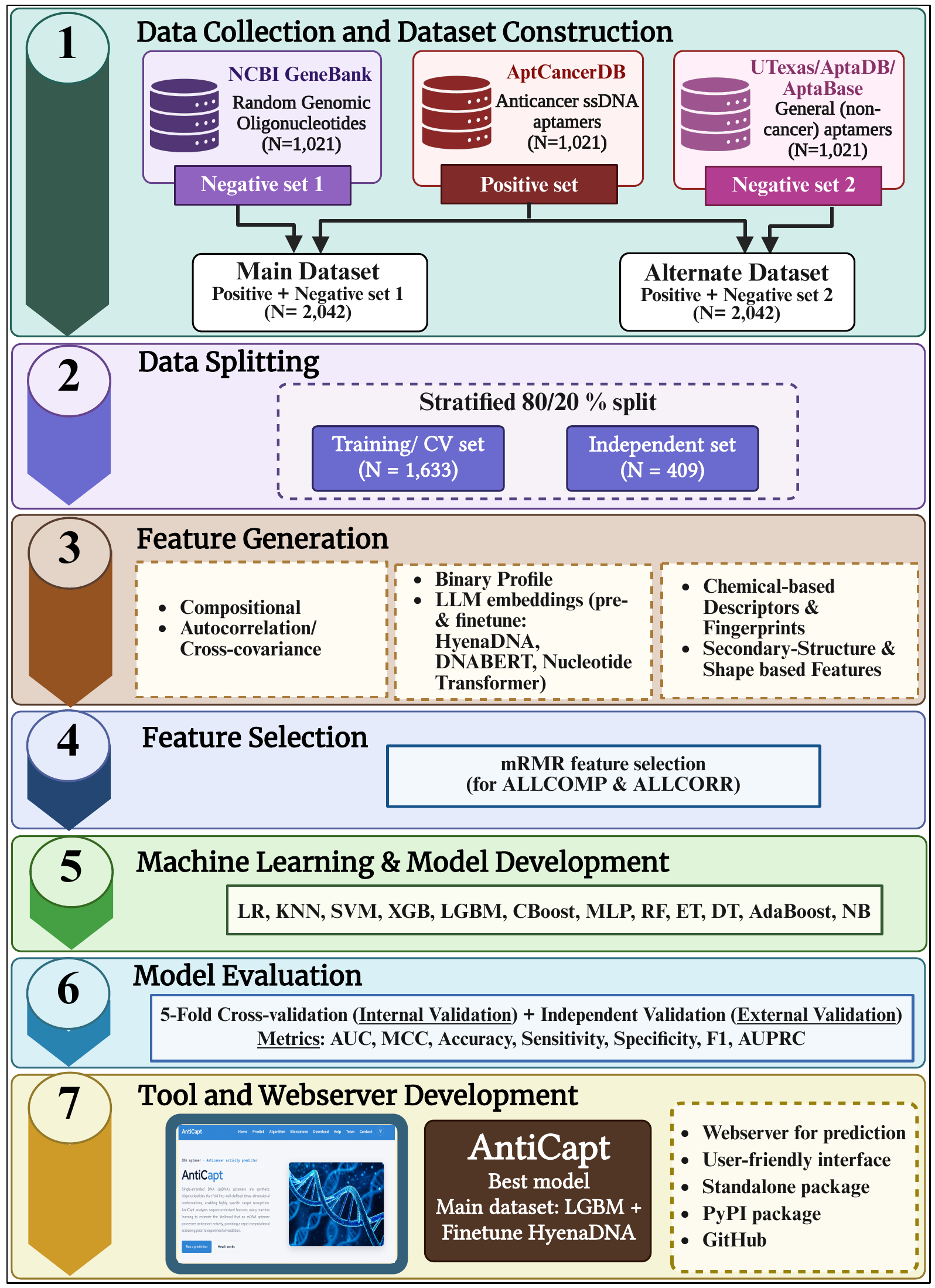
Figure 1. End-to-end workflow used to build AntiCapt, from dataset construction through webserver deployment.